Sabah's acoustic forest giant
Great Argus
The Great Argus is the defining voice of the Bornean rainforest. It takes patience and the right hide to turn the famous call into a sighting.
The bird
A terrestrial gamebird
Measuring up to two metres long, the male Great Argus maintains cleared dancing grounds in Sabah's primary lowland forests. On most stays at Borneo Rainforest Lodge, its resonant call is heard daily and carries more than one kilometre. A sighting is a realistic target for people willing to wait silently in a ground hide.
The Great Argus (Argusianus argus) is an evolutionary marvel that operates differently from almost every other gamebird. The Bornean subspecies is Argusianus argus grayi. It is slightly smaller than the birds found in Peninsular Malaysia and shows a deeper rufous-brown chest with prominently whiter spots on its back. The species was uplisted to Vulnerable on the IUCN Red List in 2020 because of habitat fragmentation across Southeast Asia.
These 3 facts explain how the bird lives and displays. First the male lacks a uropygial gland. This is the preen gland that other birds use to distribute oil and waterproof their feathers. Without it the Argus is highly vulnerable to waterlogging. When the afternoon downpours start the birds seek dense cover and fall completely silent to conserve energy for thermoregulation.
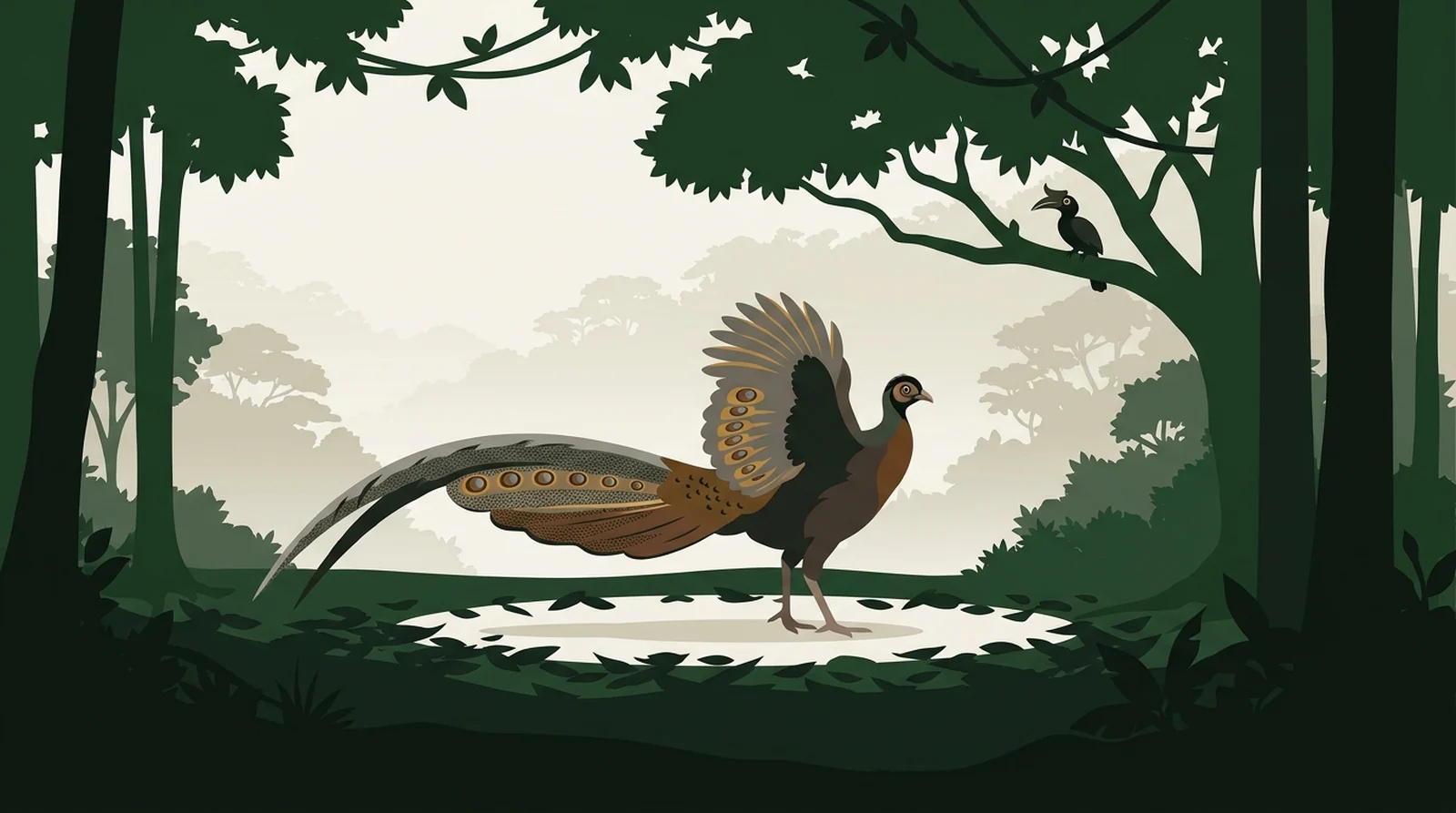
Second the famous "eyes" or ocelli are not on the tail. The male has enormously elongated and broadened secondary flight feathers on his wings. During the climax of his courtship dance he bows his head toward the ground and throws these wings forward to create a massive circular fan while the 2 very long central tail feathers stand vertically behind it. The reproductive output is extraordinarily low for a bird this size. The female lays a clutch of exactly 2 eggs and incubates them entirely alone for 24 to 25 days. The female handles all parental care.
Third the display is an actual optical illusion. For 150 years scientists debated whether the shading on the ocelli looked like a three-dimensional shape to a female bird. In 2022 a study in Biology Letters confirmed that avian vision processes these flat pigment patterns as 3D convex spheres hovering in space.
Lowland and hill forests
The species is tightly bound to primary lowland and hill dipterocarp forests up to roughly 1,300 metres in elevation. It avoids swampy inundation zones and heavily logged areas.
Danum Valley Conservation Area This 438 km² protected area is the definitive stronghold for the species in Borneo. Acoustic monitoring confirms a high density of calling males throughout the forest. The Takala Bird Observation Station sits near an active dancing ground at Borneo Rainforest Lodge. The male here is habituated to human presence inside the hide. A construction and expansion project runs at the lodge from 1 January 2025 to 22 January 2027 to add 9 chalets.
Tabin Wildlife Reserve The lowland sectors of Tabin hold a strong population. You will hear them calling frequently from the deep brush along the Core Area Road and near the Lipad mud volcano. The dense secondary vegetation means views are usually brief as a bird runs across a track.
Kinabatangan River Blocks The birds occur in the drier unflooded lowland blocks around the Sukau buffer zones and the Gomantong Cave surrounds. They entirely avoid the swampy seasonal inundation zones along the river edge so territories here are sparse.
Gunung Mulu National Park The birds are present in the primary forest heading toward Deer Cave in Sarawak. The raised boardwalks keep you out of the mud but make a quiet approach to a calling bird harder.
Moonlight and rain
The birds lack a compressed calling season because females have the physiological capacity to lay clutches in any month of the year. The males have to maintain their territories and advertise constantly so they can be heard year-round.
Rain suppresses activity completely. A bird with no waterproofing will not risk its massive flight feathers in a storm. Time your hide vigils for dry mornings.
Moonlight also changes their behaviour. A 2021 study in PLoS ONE revealed that a large portion of calling happens at night. This nocturnal calling spikes significantly during a new moon when the forest is darkest. When the moon is full the birds go silent to avoid drawing the attention of predators like the Sunda clouded leopard to their canopy roosts.
Finding the Great Argus
Guides trace the sound to find the male's territory. The sheer volume of the call comes from an arched hyoid bone in the throat that provides the muscular leverage to project the sound through dense vegetation.
The Great Argus operates on an exploded-lek mating system. The male maintains a large exclusive territory centred on a dancing ground. He spends hours carefully clearing an arena 4 to 6 metres wide on the forest floor. A persistent myth says the bird scratches the ground clear with his feet like a chicken. In reality he picks up leaves and twigs with his bill and tosses them aside. He then uses powerful percussive wing-flaps to blast the finer debris away.
Older field guides sometimes list a Double-banded Argus based on a single mysterious feather found in 1871. Taxonomic consensus proved this was merely an asymmetrical mutant feather from a standard Great Argus and the species was officially removed from the IUCN list in 2012. You are looking for the one true species.
Once a guide locates an active dancing ground they know the male will return to it daily to maintain the space and wait for females.
Camera equipment and hides
Photographing an Argus display is an extreme technical challenge. The dancing grounds sit under a dense canopy that blocks almost all of the sunlight. To freeze the micro-vibrations of the feathers during a display you need a fast shutter speed in abysmal light. Photographers push modern sensors to ISO 6400 or 12800 to get the shot.
The physical size of the bird creates a depth of field problem. An adult male measures up to 2 metres long with a tail extending up to 143 cm. When he shifts from a resting profile to a full frontal cone the physical depth of the subject changes drastically. To keep both the 3D shading on the wing fans and the bird's head in sharp focus you cannot shoot wide open. You need an aperture of f/8 or f/11. This reduction in light makes a heavy fluid-gimbal tripod essential to allow for slower shutter speeds without introducing micro-camera shake.
Experienced photographers avoid 600mm or 800mm prime lenses in the hide. The bird is huge and the viewing ports are close to the arena. A 300mm or 400mm lens ensures you do not clip the massive wing fans out of the frame when the display reaches its climax. Guides also warn against spraying mosquito repellents containing DEET on your hands as the chemical will rapidly melt the rubber grips on camera bodies during the long humid vigils.
Responsible Argus watching
Keep still and quiet inside an Argus hide. The bird's hearing is tuned to detect the rustling of terrestrial predators. Zipping a camera bag or tearing velcro or even hushed whispering will empty the arena instantly. You need to wear dark clothing and keep the interior of the hide darker than the jungle outside so the bird cannot see your movements through the viewing ports. Flash photography is strictly forbidden.
The species faces intense pressure from snaring. Males are predictable because they use the same pathways to enter their dancing grounds. In Borneo the long tail and secondary feathers are highly prized for ceremonial headdresses worn during cultural festivals like Gawai. Taking a mature male out of the forest is disproportionately destructive because it removes the most genetically dominant bird from the local hierarchy. Every visit to a managed conservation area funds the patrols that keep these forests intact.
Your travel schedule
If the Great Argus is your primary reason for coming to Borneo send the team your dates and your camera setup. They will build an itinerary that puts you in the right hide at the right time. They can also sequence your stay with the coastal reserves and the Kinabatangan River to give you the full range of Sabah's wildlife.
--- Sources referenced on this page: IUCN Red List of Threatened Species (2020). Biology Letters (Firkins & Kelley, 2022). PLoS ONE (Clink et al., 2021). Facts verified 9 September 2026.
Related
Keep planning
Questions the team is asked
The bird spends its life on the dark forest floor and possesses incredible hearing. It will detect your footsteps and walk quietly away through the dense undergrowth long before you get a line of sight.
No. His display feathers are too long and delicate for foot-scratching. He clears his dancing ground by tossing debris with his bill and blasting the dirt clean with powerful wing-flaps.
Yes. A large portion of their calling happens after dark. They are most vocal at night during a new moon when the pitch-black forest hides them from predators.
A 300mm or 400mm lens is usually better than a 600mm. The male is up to 2 metres long and a very long lens will crop his huge wing fans out of the frame when he displays.
Plan your trip
Tell the team your dates
Send the team your travel dates and camera setup to plan a Great Argus itinerary.