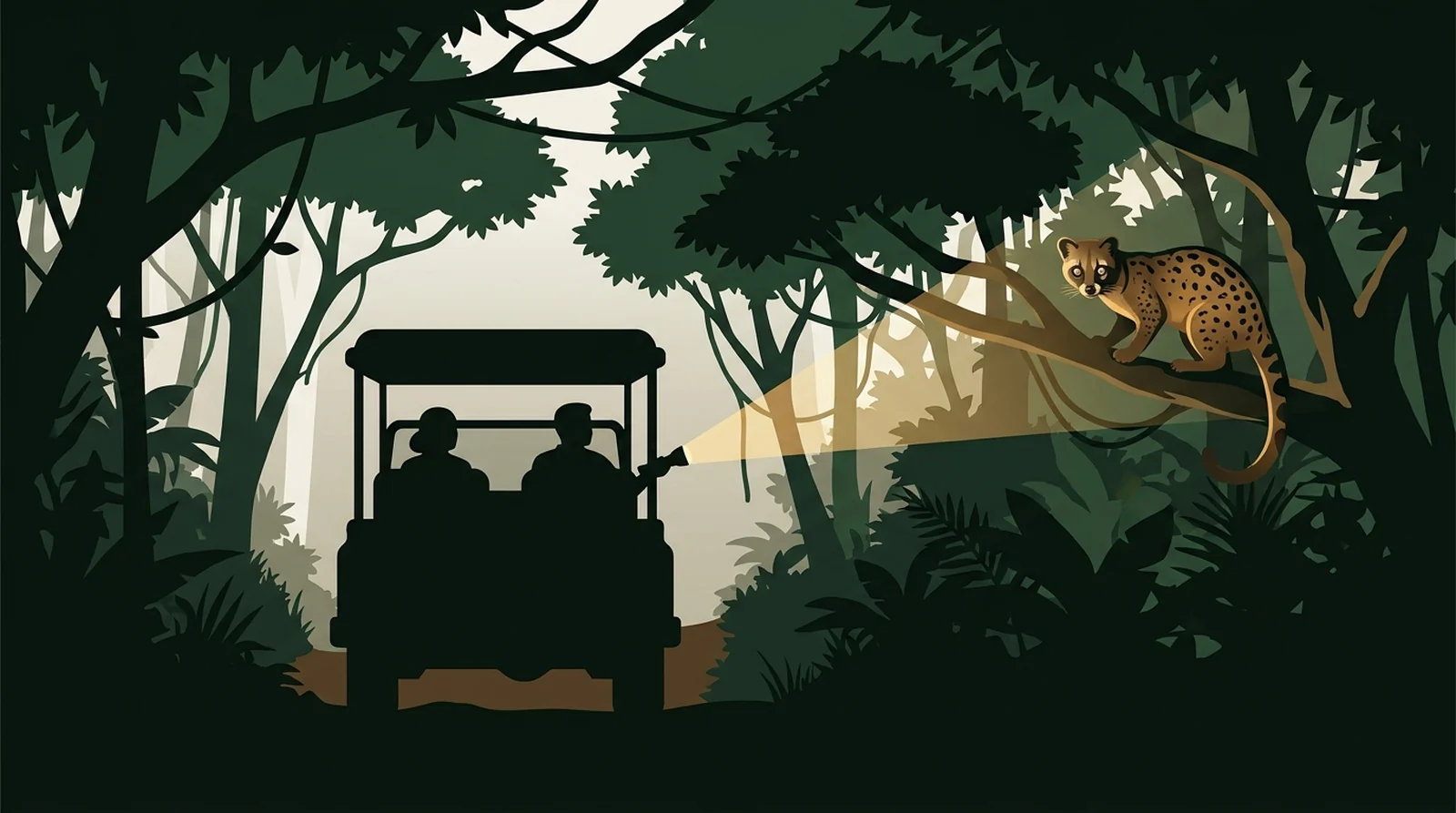
Danum Valley after dark
Danum Valley Night Safaris
A night drive is the best way to see the rainforest mammals that sleep through the heat of the day. This guide explains how the drives work, what the guides look for and what you are likely to see.
What it is
Slow vehicle patrols
2.5 hours from Lahad Datu, Danum Valley protects 438 square kilometres of lowland rainforest. When the sun sets and diurnal birds roost, you will join a slow vehicle patrol to find nocturnal mammals. You will spend 2 hours sweeping the dense canopy with red-filtered spotlights to look for animal eye reflections.
A night drive is a slow vehicle patrol along the access roads that cut through the forest. Because you are seated, you can cover far more ground than you would on foot.
The vehicles depend on where you stay. Borneo Rainforest Lodge has introduced silent electric buggies for the drives near the lodge. These drastically reduce engine vibration and acoustic disturbance so they allow a very quiet approach. They give you a significant advantage when you are trying to observe highly sensitive mammals without startling them.
The Danum Valley Study Centre is a working research station and relies on robust 4x4 safari vehicles to handle the rugged logging roads. Both options elevate you above the vegetation and give you clear sightlines into the mid-canopy. If it rains heavily the drives are paused because mammalian activity drops while the animals seek shelter. Your guide will often substitute a cancelled drive with a slide presentation or a session looking for amphibians around the lodge.
The evening forest
If the night drives are what you're coming for, tell the team which animals matter most and they'll build the nights around them.
The drives suit almost anyone who can climb into a vehicle. Because you do not have to watch your footing or deal with terrestrial leeches, you can look up into the trees continuously. If you are travelling with children or find the daytime humidity difficult, the evening temperature is much more comfortable.
Rainforest nocturnal mammals
Most people hope for cats but the reality of a Bornean night drive is a rich mix of civets, flying squirrels and sleeping birds.
Sightings of the Malay civet and the common palm civet happen on most stays. Red giant flying squirrels and greater mouse-deer are regular on the night drive. You will hear an immense chorus of frogs and insects as soon as you step outside.
The nocturnal primates require a skilled guide. The western tarsier and the slow loris are resident primates seen with luck resting in the dense vines.
The Bornean wild cats are the ultimate prize. The leopard cat is a realistic target for patient visitors but the marbled cat, the flat-headed cat and the Sunda clouded leopard are seen with luck. Camera trap studies show just how rare they are in the deep forest. Enjoy the civets and primates and treat any cat as a bonus.
Reflected eye shine
Your guide finds animals by looking for eyeshine. Many nocturnal mammals have a reflective layer at the back of the eye called the tapetum lucidum. It acts as a biological mirror to help them see in the dark.
When the guide sweeps a light across the forest, the beam hits this layer and reflects straight back. The guide holds the torch precisely at eye level so they can intercept that narrow returning beam. Crocodilians in the river reflect bright red. Civets reflect yellow-green. The slow loris reflects an orange or amber glow.
Tarsiers are different. They do not have a tapetum lucidum at all so their eyes do not shine. They evolved massive eyes to capture ambient light instead and your guide has to find them by spotting their silhouette in the canopy. Thermal imaging monoculars are occasionally used to scan the trees for heat signatures before the guide turns on a spotlight but the high humidity of the rainforest limits their range.
Lodge foot trails
A night walk is a completely different experience that focuses on the macro details of the forest. You will walk slowly along the trails near the lodge to look for stick insects, sleeping birds, frogs and spiders. Spiders have tapeta in their lateral eyes and reflect light like scattered diamonds in the leaf litter.
The terrain suits people who are steady on their feet. You will have to negotiate uneven roots and mud in the dark so a walk requires far more concentration than a drive. If you prefer to cover ground and look for mammals, the drive is the better choice. If you want to see pit vipers and intricate insects up close, ask for a walk.
Lightweight clothing and optics
Comfort in the dark relies on the right clothing. The humidity stays near 80 per cent even at night so lightweight layers are essential.
If you are taking a walk, leech socks are mandatory. Standard hiking socks do nothing to stop terrestrial leeches so you must wear the tightly woven gaiters that pull up to your knees. A headlamp leaves your hands free to handle binoculars or a camera.
Binoculars are an excellent tool at night. While you might assume you need a massive objective lens, an 8x42 model is the practical limit. The 8x magnification provides a wide field of view to help you find the animal in the dark and it is much easier to hold steady than a 10x model. A close-focus feature is critical for inspecting insects from a safe distance.
Red-filtered light beams
Flash photography is explicitly banned on all Danum Valley night safaris. A bright white flash causes temporary blindness in nocturnal primates and cats. This severely disrupts their ability to hunt and navigate.
Modern guides rely on red-filtered spotlights. Nocturnal primates like the slow loris are dichromats and lack the genetic structure to see deep red light as a bright colour. A red beam causes far less disturbance and prevents their retinas from bleaching. If you are bringing a headlamp, make sure it has a red mode.
If you want to photograph animals at night, you need a modern camera that handles high ISO settings well. The suspension cables on the canopy walkway sway too much for tripods and standard tripods are cumbersome on the narrow trails. A monopod or in-lens image stabilisation will give you the best results from the vehicle.
Where it runs from
Choose your base
Itineraries built around it
Questions the team is asked
The drives typically run for 1.5–2 hours and start around 8pm after dinner.
No, your guide will carry a professional high-powered torch. A personal headlamp with a red setting is useful for walking to the vehicle or doing a night walk.
Yes, provided you stay on the designated paths with your guide. The mandatory guide rule ensures you do not get disoriented.
Thermal monoculars can be used to scan the canopy but the extreme humidity and warm ambient temperatures of the rainforest reduce their contrast. They are excellent for locating animals silently before using a red light to identify them.
Plan your trip
Plan your Danum Valley trip
Tell the team which nocturnal mammals matter most and they will build your Danum Valley night safaris around them.