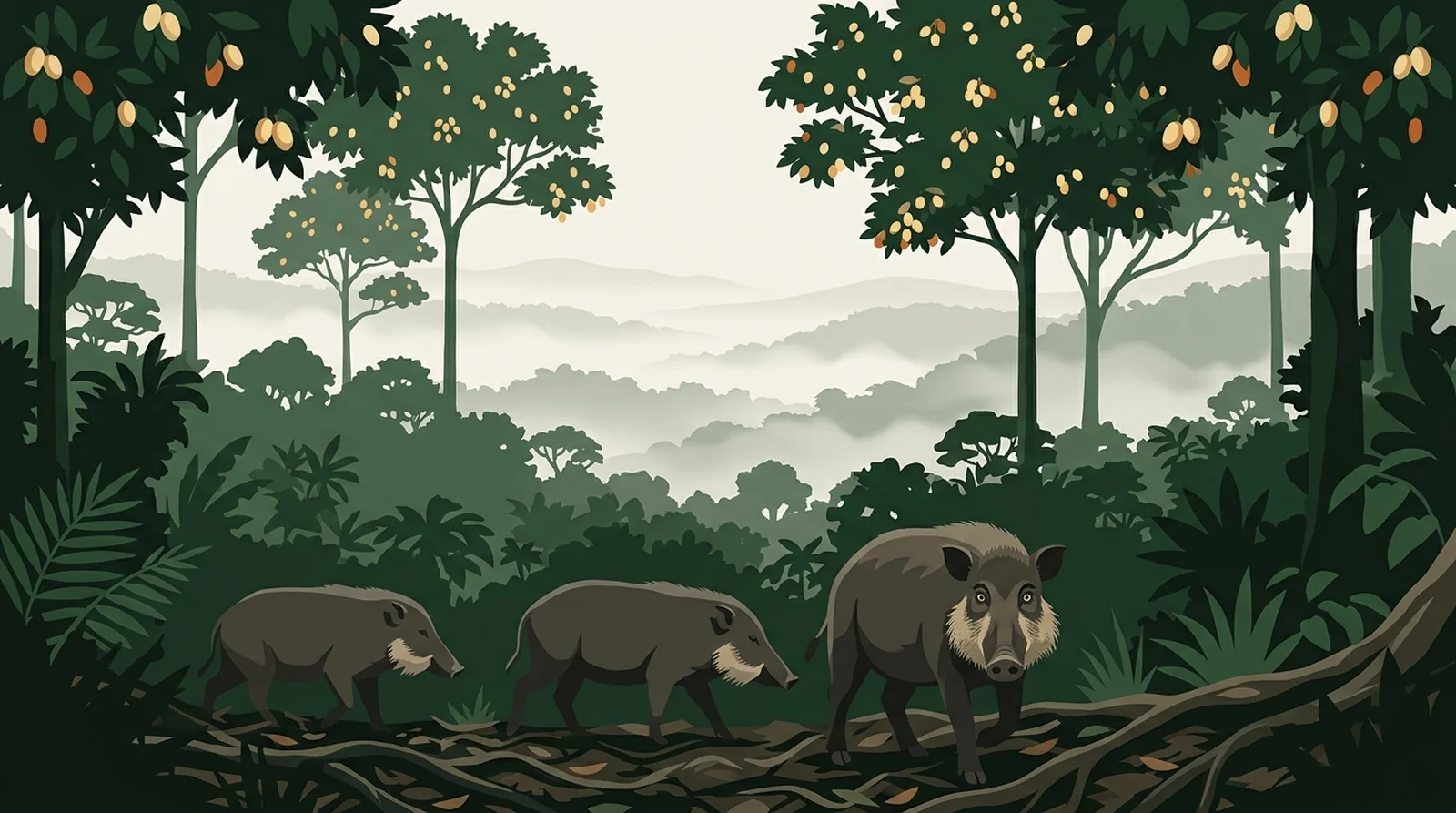
Borneo's lowland rainforest operates on a massive irregular fruiting cycle that once drove vast migrations of bearded pigs. This guide explains how the mast works and where the pigs stand today after the 2021 population collapse. Expect to step into an ecosystem in transition as the forest slowly adapts to their absence.
The apex seed predators
The Bornean bearded pig is an apex seed predator shaped entirely by the unpredictable nature of the rainforest. The dipterocarp trees that make up the vast majority of the canopy biomass in places like the Danum Valley Conservation Area withhold their fruit to starve local seed predators. This evolutionary strategy creates long periods of famine. During these lean intervals, the pigs survived by scrounging for roots and earthworms in the dark understorey.
The lack of substantial calories kept the resident predator populations naturally low and caused severe emaciation among adult pigs during prolonged non-mast periods. The pigs possessed an extraordinary capacity to endure these deficits. They operated as residents in small numbers across the landscape while waiting for the environmental signal that would transform their environment. Their entire physical and reproductive ecology was calibrated to explode the moment the forest provided enough energy to support them.
The vast regional herds
The signal for the feast arrives with the El Niño-Southern Oscillation. The specific climatic trigger is either a prolonged dry spell with minimal rainfall or a sudden drop in minimum nighttime temperatures caused by the influx of dry air clearing the equatorial cloud cover. When the trees detect this anomaly, they shift their cellular development from leaf buds to flowers. Hundreds of distinct species and genera take part in the same flowering event with different dipterocarp species blooming in sequence. This triggers the bearded pigs to begin moving.
Before the disease outbreak, the pigs undertook massive regional migrations to reach the most productive forests. They gathered into vast herds numbering in the hundreds or thousands and traversed hundreds of kilometres to converge on masting hotspots like Danum Valley and the Maliau Basin. They followed the changing canopy and arrived just as the specialised winged seeds began to detach and spin to the ground like miniature helicopters. The air filled with spinning seeds and the forest floor became a dense mosaic of nutrients. The tracking behaviour of the herds made them a central spectacle for visitors and a vital component of the lowland ecology.
The dipterocarp seed rain
The dipterocarp masting strategy is known as predator satiation. The trees drop so much fruit at once that the local seed predators cannot possibly consume it all. A single hectare of primary forest can receive nearly 200 kg of seeds over 6 weeks. The bearded pigs were the primary targets of this overwhelming bounty. The seeds they consumed are heavily laden with lipids and lack physical or chemical defences.
The sudden caloric surplus from these illipe nuts triggered an immediate and massive reproductive event. A single female bearded pig fuelled by the mast resources could produce multiple litters of 12 or more piglets in 1 year. The population rapidly expanded to match the available food supply.
The animals gorged themselves to complete physical satiation. Other forest residents joined the feast including murid rodents and Malay civets while Malayan sun bears relied heavily on the sudden bounty to recover body condition. The sheer volume of the seed rain overwhelmed the expanded pig herds and left millions of viable seeds completely ignored on the forest floor. These surviving seeds germinate almost immediately to form a dense lawn of seedlings that sit in suspended animation in the understorey. They wait patiently for a canopy tree to fall and provide a life-giving gap of sunlight.
The viral disease outbreak
That dynamic changed when a highly contagious viral disease jumped from the Asian mainland to Borneo. African Swine Fever appeared in wild bearded pigs in the Kinabatangan region in December 2020 and veterinary authorities confirmed the outbreak in Pitas in February 2021. The virus swept across the island with immense speed. Models using citizen science data from the Babi Hutan Project indicate the disease spread at nearly 1 km a day initially and accelerated to over 4 km a day after 400 days.
The outcome was catastrophic for the species. A 2026 study published in Mammal Study by Chong and colleagues conducted extensive camera trapping along the western boundary of the Tabin Wildlife Reserve. Across thousands of trap-nights the researchers documented a near-total collapse in bearded pig detections compared to a baseline survey from a decade earlier. The survey recorded 0 juveniles and a total failure of recruitment. The disease suspended the great migrations that once defined the forest cycle.
The forest without pigs
The absence of the bearded pig leaves a massive ecological vacuum. The pigs operated as vital ecosystem engineers during the mast events. Their intense rooting and foraging turned over the forest soil to prepare the ground for new growth. They were also a cultural keystone species that historically provided the majority of the hunted animal biomass for inland indigenous communities across Borneo.
Without the pigs to consume the fallen seeds, the survival rates of dipterocarp seeds face radical changes. The minor localised mast events recorded in 2023 and 2024 demonstrated an altered ecosystem response. The competitive dynamics of the seedling bank are shifting in the absence of the primary seed predator. The long-term cascading effects on secondary consumers like the Sunda clouded leopard that previously preyed on young piglets are still unfolding across the protected areas.
Bearded pig sightings today
The immense herds of the past are gone and the great migrations remain suspended. Early signs of recovery exist and bearded pigs are seen with luck. Researchers’ remote camera traps occasionally record isolated individuals or tiny family groups.
A sighting on a guided trek today is a profound event and a privilege. It offers a glimpse of a fragmented population beginning the slow process of rebuilding against severe biological pressure. While the pigs recover, the guides focus the night drives and walks on the thriving populations of adaptable mammals like leopard cats and common palm civets that use the forest edges.