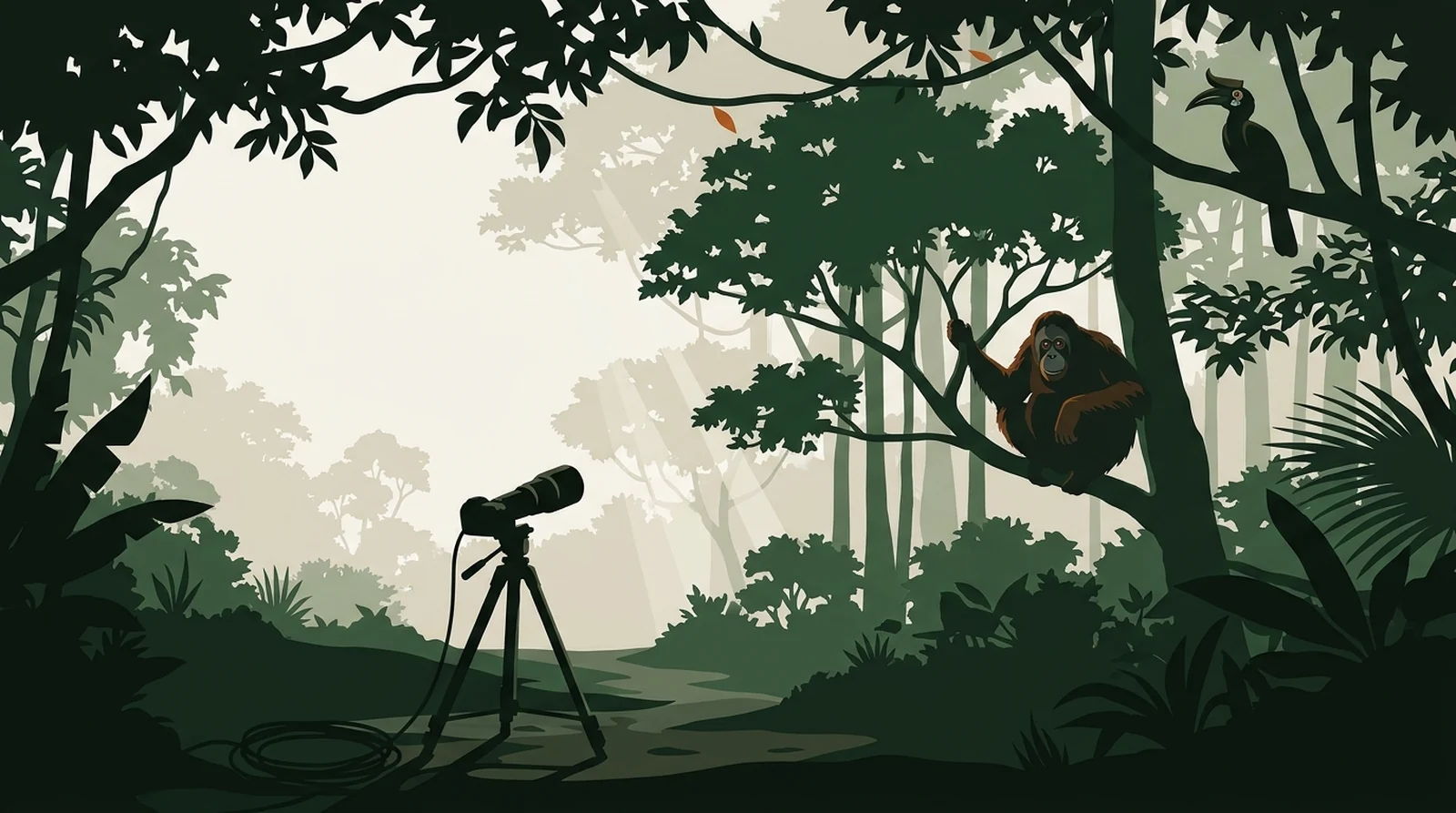
Camera crews spend months knee-deep in guano at Gomantong Cave and tracking dipterocarp trees in Danum Valley. Broadcast edits compress years of mass fruiting, but walking the trails reveals the 90-metre canopy and the damp earth. Study the specific field guides and listen to the acoustic archives before you arrive in Sabah.
Protected forests and cave systems
Producers often rely on the established reserves in Sabah to film rare animal behaviour. For Planet Earth III in 2023 the BBC Earth team captured an oriental pied hornbill sealing its nest cavity at Gomantong and along the Kinabatangan River. They spent 5 years collecting footage for the series. The Kinabatangan floodplain has been a vital artery for the Orang Sungai people for centuries and the BBC relied on the same river networks to access the wildlife.
Judi Dench's Wild Borneo Adventure, produced by Atlantic Productions for ITV in 2019, focused heavily on conservation science. The crew filmed at the Sepilok Orangutan Rehabilitation Centre and the Danau Girang Field Centre on the Kinabatangan before heading into the primary rainforest of Danum Valley. Danum Valley is 438 square kilometres of Class I Protection Forest Reserve that was never logged. The crew filmed the forest of a lineage some 130 million years old and the scientific work happening there.
The original 2006 Planet Earth caves episode featured Gomantong Cave. Producer Huw Cordey filmed the interior sequences inside the Simud Hitam chamber. The crew captured the 100-metre guano mound and the giant predatory centipedes by standing knee-deep in the dung for 5 days.
The Green Planet in 2022 sent producer Paul Williams to Danum Valley to film the giant dipterocarp trees. The crew wanted to show the mass mast-fruiting events where the canopy drops millions of winged seeds at once.
For the 2007 series Expedition Borneo, George C. McGavin and his team went deep into the centre of Sabah. They set up the Big Belian Camp at the confluence of the Imbak and Kangkawat rivers in Imbak Canyon. The area is a Class II undisturbed forest with an 8-tiered waterfall measuring 120 metres across.
Camera robots and filming locations
Television compresses time and bends geography. A sequence that takes 3 minutes to watch might have taken 2 months to film. The seed dispersal shots in The Green Planet were captured using a custom-built field robot called the Triffid. It allowed the camera to fly along roots and film leafcutter ants in continuous macro tracking shots. The dipterocarp trees coordinate their reproduction to drop millions of seeds simultaneously. This mass fruiting starves insect populations for years and then suddenly floods the forest floor. The BBC robot captured this precise biological strategy in action. You will walk past the same ants but you cannot replicate a slow-motion robotic perspective.
Documentaries also blend locations to tell a cleaner story. The Planet Earth cave episode shows an immense bat exodus followed immediately by interior shots of the guano mound. The exterior bat flights were filmed at Deer Cave in Sarawak. The interior centipedes and cockroaches were filmed inside Gomantong Cave in Sabah. They are presented as one cavern system.
The Planet Earth II sequence featuring gliding lizards is often associated with Danum Valley because acclaimed photographer Tim Laman shot stills there. The production metadata points to Bako National Park in Sarawak for the video sequences. Spotting a Draco lizard is a realistic target across Sabah but seeing one glide perfectly across a gap requires luck and patience.
Canopy heights and acoustic bands
A television cannot broadcast the scale of the landscape or the physical reality of standing in it. When you walk the trails at Borneo Rainforest Lodge you are underneath a 90-metre canopy; the lodge's construction and expansion project runs from 1 January 2025 to 22 January 2027. A camera cannot show the true height of trees like Menara. Menara is a yellow meranti standing exactly 100.8 metres tall in Danum Valley and is away from the visitor trails. Looking up at the unstratified canopy from the forest floor is an experience a flat screen cannot replicate. You feel the humidity and the damp earth. You smell the vegetation.
At Gomantong Cave a typical visit involves a 45-minute walk along a boardwalk. The BBC crew spent 60 days filming the cave episode and required respirators to handle the ammonia fumes from the guano. Walking through it gives you an immediate physical sense of the ecosystem that a clean screen completely hides. The cave is also an active harvest site for the Idahan people who hold ancestral rights to collect edible bird's nests. You will see the bamboo scaffolding they use to reach the roof. The BBC focused on the guano and the bats but a visit reveals the human economy built around the cave.
The most profound difference is the sound. The pioneer bioacoustician Bernie Krause recorded the soundscapes of Borneo in 1991 to demonstrate his acoustic niche hypothesis. He showed that insects, frogs, birds and mammals vocalise in distinct frequency bands so they do not drown each other out. Listening to the forest is as important as looking at it.
Field guides and history books
A good field guide makes a trip richer. The standard for birders is Phillipps' Field Guide to the Birds of Borneo by Quentin and Karen Phillipps. The third edition details 669 species and covers 130 specific birding sites. The companion volume is Phillipps' Field Guide to the Mammals of Borneo. It covers 277 species and provides a deep overview of the forest ecology.
For herpetology you need the third edition of A Field Guide to the Frogs of Borneo by Inger, Stuebing, Grafe and Dehling. It includes 33 new species descriptions. A Field Guide to the Snakes of Borneo by Lardner, Stuebing and Inger features close to 160 species and is essential for identifying cryptic groups like reed snakes. Botanists should find the second edition of Pitcher-Plants of Borneo by Phillipps, Lamb and Lee.
Narrative history provides the context for modern Sabah. The Sandakan Trilogy by Agnes Newton Keith is a first-hand account of colonial life and wartime internment. Into the Heart of Borneo by Redmond O'Hanlon remains a classic 1984 travelogue of a journey up the Rajang River in Sarawak. The Wasting of Borneo by Alex Shoumatoff details the ecological pressures facing the island today.
Documentary episodes and audio archives
Before you travel it is worth watching Earth's Tropical Islands: Borneo (2020) produced by Ingrid Kvale. The episode explains how intense competition in nutrient-poor soils drove the island's extreme biodiversity. It also features sequences of the Sama Dilaut communities on the coast. These maritime people are often known as the Bajau Laut. They are stateless and live much of their lives on the water. They have a genetic mutation that gives them an enlarged spleen. This physiological marvel allows them to free-dive to 70 metres and spend much of their day underwater. Seeing this on screen prepares you for the reality of the Semporna archipelago.
Attenborough's Life in Colour (2021) is another excellent primer. The series uses specialised cameras to show how animals see ultraviolet and polarised light. The insights into tropical ecology help explain the survival strategies of the endemic species you might see.
You should also listen to Bernie Krause's Wild Sanctuary Borneo archives or the companion audio to his book The Great Animal Orchestra. Familiarising yourself with the natural acoustic bands makes it much easier to identify calls when you are standing on a trail at dawn.
Kinabatangan and Danum itineraries
A trip that takes in the locations seen on screen usually sequences the Kinabatangan River with a stay in Danum Valley. Send the team your dates, your party size and the wildlife you are hoping to see. They will come back with an itinerary that matches the reality of the forest to the time you have available.
--- Sources referenced on this page: BBC Natural History Unit (2006, 2016, 2022, 2023), Atlantic Productions (2019), Discover Magazine (2006). Facts verified 9 September 2026.