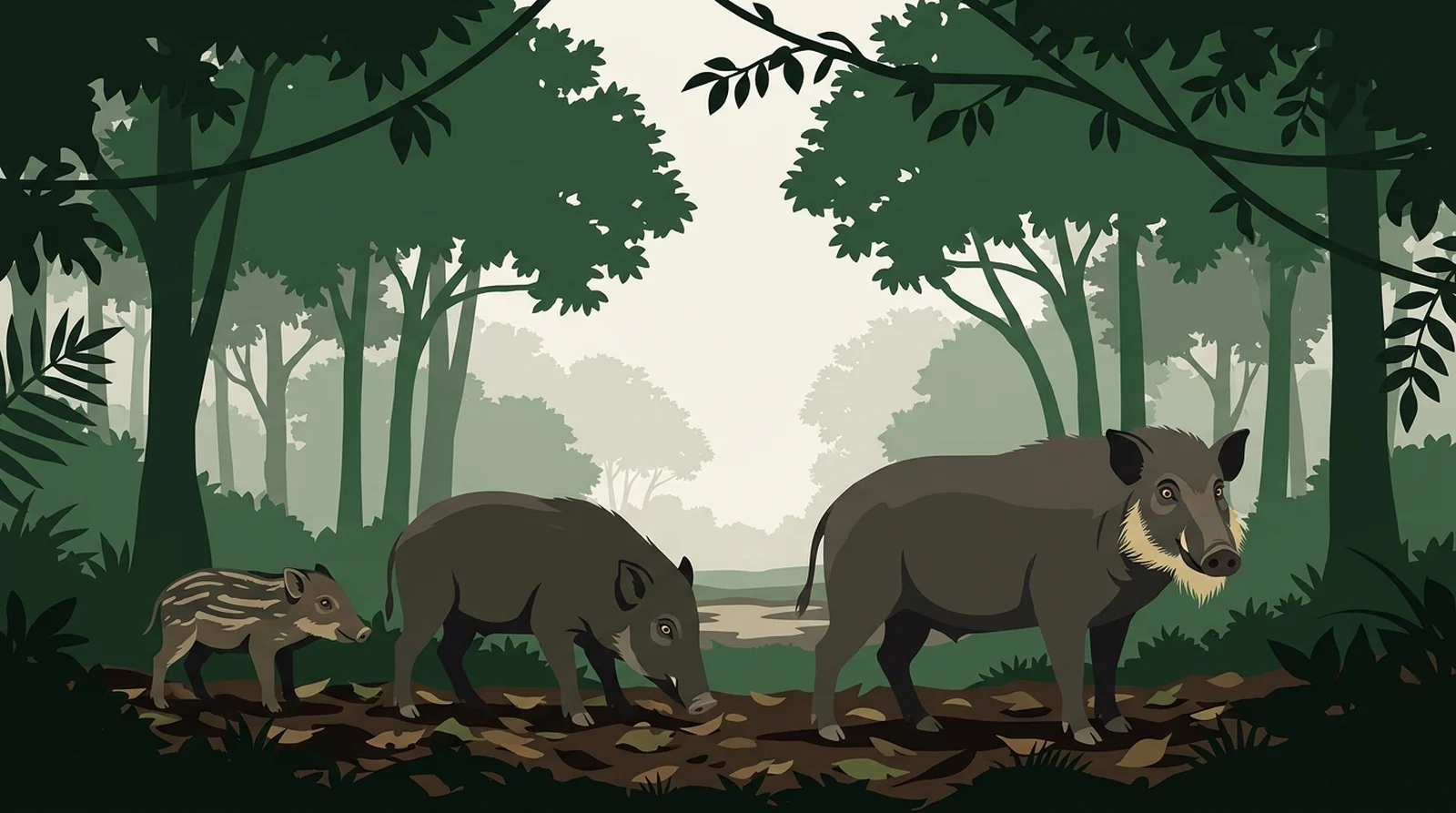
Sabah's forest gardener
The Bornean Bearded Pig
The Bornean bearded pig is a vital ecosystem engineer. This guide explains its role in the rainforest and how a recent disease outbreak changed sightings.
The animal
The Bornean bearded pig
The Bornean bearded pig is a large mammal that shapes the rainforest floor by turning over the soil. Before the disease outbreak in 2020, it was a ubiquitous presence around the lodges and trails of eastern Sabah. Today it is a much rarer sight, but you can still look for this ecosystem engineer if you plan your itinerary carefully.
You can recognise the Bornean bearded pig (Sus barbatus) by the dramatic bristles around its snout. They are highly social animals that typically move in family groups known as sounders. Historically their populations fluctuated dramatically in tandem with the irregular cycles of the rainforest's mast-fruiting trees.
Huge numbers of bearded pigs would migrate to gorge on the sudden abundance of fallen seeds during a mast year when dipterocarp trees fruit synchronously across the canopy. These mass migrations were one of the most spectacular wildlife events in Southeast Asia. The pigs would follow the fruit drop across vast distances and gather in feeding aggregations that numbered in the hundreds.
The species is officially classified as Vulnerable on the IUCN Red List. This assessment dates to 2017 and is now considered heavily outdated following the severe population crashes of the last few years. The current conservation reality is much more precarious and researchers continue to monitor the surviving populations across Borneo.
Soil turnover and micro-habitats
Bearded pigs are fundamental to the health of the Bornean rainforest. Their constant rooting behaviour is a vital mechanism for soil turnover and seed predation. They travel through the undergrowth in sounders and use their powerful snouts to dig for roots and fallen fruit. They help the rainforest regenerate and process nutrients at a massive scale by turning the soil. The physical act of tilling the leaf litter shapes the ground layer of the forest and ensures the survival of numerous plant species.
Their daily activity also engineers essential micro-habitats for other animals. The large mud wallows they create and maintain in the forest floor provide crucial spawning pools for amphibians. Species like Wallace's flying frog rely almost entirely on these ephemeral muddy pools to mate and lay eggs. Before 2020 these wallows were reliably engineered by the daily bioturbation of massive bearded pig sounders. Today the availability of these specific spawning habitats has likely contracted.
The pigs historically served as the main terrestrial prey base for the Sunda clouded leopard forming the base of the food web for the apex predators of the Bornean rainforest.
Bako and Sabah reserves
Bako National Park in Sarawak offers exceptional on-foot encounters. The pigs are resident in the coastal beach forest and mangrove fringes here. They are a realistic target on most stays and you can see them with luck foraging near the park headquarters.
In Sabah's Danum Valley Conservation Area they are seen with luck. Before 2020 they were seen on most stays around the lodge kitchens and trailheads but today an encounter on the trails behind the Danum Valley Study Centre or Borneo Rainforest Lodge is a bonus for early risers.
At Tabin Wildlife Reserve they were once among the most frequently encountered large mammals. Today they are seen with luck along the plantation edges.
The African swine fever outbreak
The African swine fever epizootic swept through the Indonesian archipelago and Malaysian Borneo between late 2020 and 2024. The virus devastated wild pig populations and changed wildlife encounters across the region. The impact on the bearded pig was sudden and profound. Researchers tracking bearded pigs across major protected areas in Sabah including Tabin Wildlife Reserve and the Ulu Segama landscape around Danum Valley confirmed a population decline of around 99%.
A 2026 camera trap study in the western section of Tabin Wildlife Reserve documented the decline using data collected in 2023–2024. Researchers compared fresh data collected across 8,760 trap-nights to a baseline survey from 2010 to 2012. They recorded 0 juveniles. This absence of young indicates a total failure of recruitment and an ongoing active suppression of the population by the endemicised virus. In eastern Sabah, bearded pigs are now seen with luck.
The secondary ecological impacts of this collapse are still unfolding. Bearded pigs were the primary terrestrial prey base for the Sunda clouded leopard. The sudden loss of this prey may alter apex predators' hunting behaviours and trigger wider changes across the rainforest food web. The absence of the pigs also changes the forest floor regeneration process because the soil is no longer turned over at the same rate.
Herds were historically seen daily at Tabin and Danum but guidebooks presenting those encounters as current advice repeat outdated claims. Tentative signs of localised recovery were noted in late 2024 but the pig remains ecologically absent across much of its former Sabah range. Be sure to ask your guide about any recent trail sightings when you arrive. The recovery of the species is an unfolding story.
Camera settings and lenses
Remnant individuals or small sounders encountered on the trails are typically terrestrial, localised and relatively slow-moving when foraging. This deliberate pace is a major advantage for wildlife photographers working in the deep shade of the rainforest understory. The permanent gloom of the primary forest canopy absorbs most of the available sunlight so you must manage your exposure settings carefully.
You can safely drop your shutter speed to 1/250s because the pigs move predictably when rooting in the soil. A standard 70–200mm f/2.8 zoom lens provides excellent framing flexibility for these encounters. It allows you to capture tight portraits emphasising their unique facial morphology and dramatic bristled snouts or wider environmental shots that show them turning the rainforest soil.
In poor lighting conditions you should rely on the image stabilisation in your lens and push your camera sensor to ISO 3,200 or 6,400. A sharp image containing digital noise is always preferable to a motion-blurred image captured at a lower ISO setting.
Related
Keep planning
Best Time to Visit Sabah Getting to Danum Valley Sabah Itineraries
Questions the team is asked
Bearded pigs are focused on foraging and will move away from human activity on the trails. Keep a respectful distance if you encounter a sounder with piglets and follow your guide's instructions.
Their migrations are tied to the irregular mast-fruiting cycles of the dipterocarp trees. These cycles occur every 2 to 10 years. They travel when the forest produces a massive surplus of seeds rather than on a strict annual calendar.
Sightings at Danum Valley are a bonus rather than an expectation following the 2020 disease outbreak. They are seen with luck on the trails and the team will let you know if any have been active recently.
Bako National Park in Sarawak is a realistic target for seeing bearded pigs. The coastal forest supports a resident population that you can watch on foot with luck.
Plan your trip
Plan your wildlife itinerary
Tell the team you want to look for bearded pigs and they will build your itinerary around the reserves with the highest current activity.