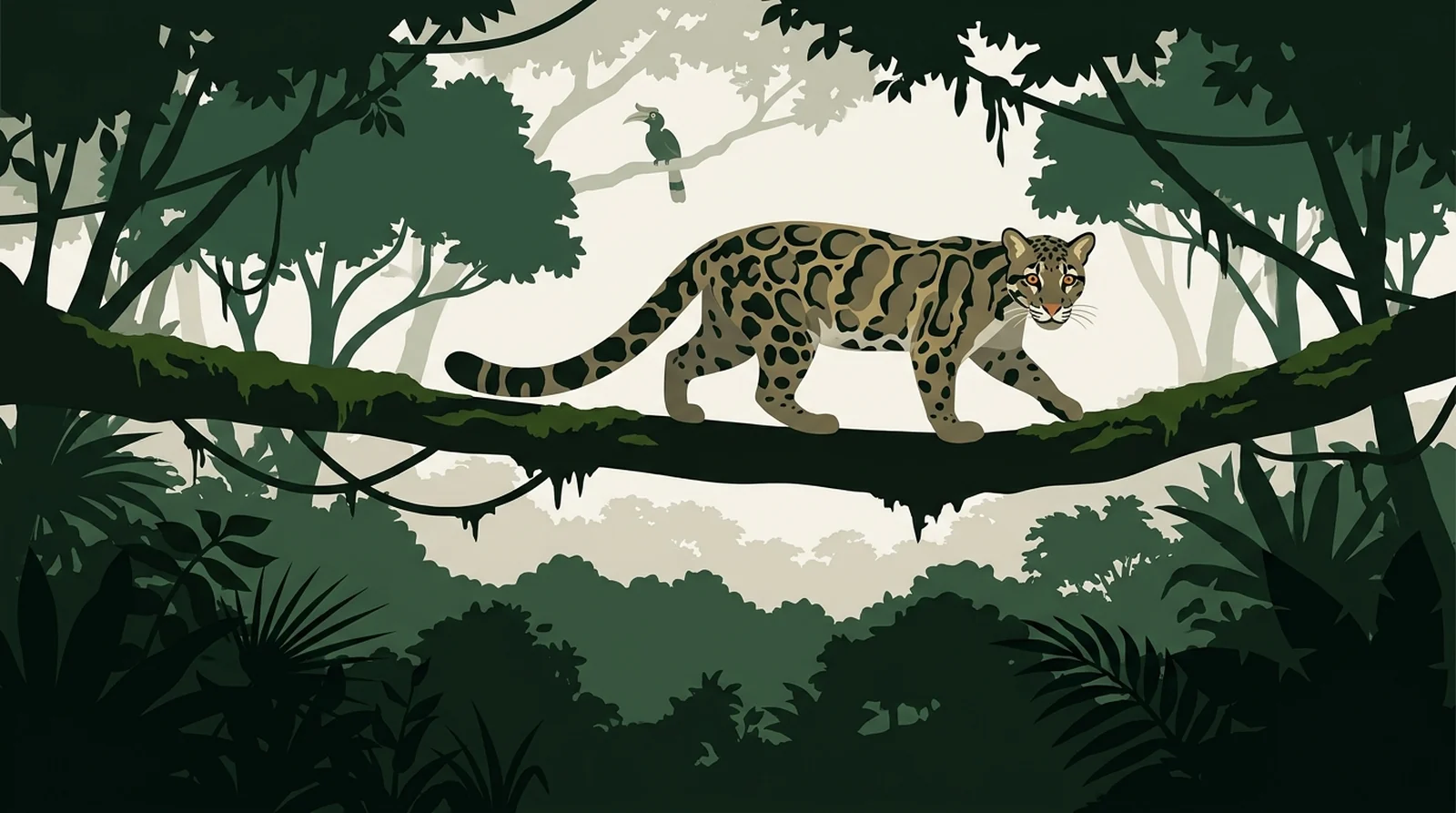
Borneo's apex predator
The Sunda Clouded Leopard
The Sunda clouded leopard is the terrestrial predator people come to Borneo for. Here is where the guides look for it and what changes your chances.
The animal
The distinct island subspecies
The Sunda clouded leopard operates at naturally low densities across massive home ranges in the commercial reserves of Sabah. Finding this cat requires stamina for eight-hour night drives along logging tracks where prey is abundant. You will spend long hours in the dark, but seeing Borneo's apex predator on the track makes the effort worthwhile.
For decades science treated the clouded leopard as a single species spread across mainland Asia and the islands. That changed in 2006 when molecular analysis identified 36 fixed nucleotide differences between the mainland populations and those on Borneo and Sumatra. This genetic distance is comparable to the gap between a lion and a leopard. Morphological studies confirmed the split by identifying smaller and darker cloud markings on the island cats. The IUCN Red List assessed the resulting new species as Vulnerable in 2015 and the distinct Bornean subspecies (Neofelis diardi borneensis) as Endangered in 2008.
An adult male weighs up to 25 kg. The cat possesses rotating rear ankles that allow it to climb down trees head-first and hang from branches by its hind claws. It also carries the longest canine teeth relative to skull size of any living feline. These jaws deliver a shearing bite adapted for bringing down large terrestrial prey like sambar deer and bearded pigs.
The forest floor hunter
The old image of the clouded leopard is a cat that spends its entire life in the canopy. Camera traps and GPS telemetry collars have corrected that picture. The species is highly adept in the trees but it is fundamentally a terrestrial hunter. It patrols its territory and stalks its prey on the forest floor and along man-made trails.
The clouded leopard fills the niche of the apex terrestrial predator because it moves on the ground in a landscape where tigers and leopards do not exist. Researchers estimate a population of roughly 754 individuals across Sabah. Spatially explicit capture-recapture models place the density at 1.27 to 2.82 individuals per 100 square kilometres in the state's commercial forest reserves. That low density explains why seeing one is difficult and why a sighting is the reward for patience.
Logging roads and reserves
Success comes from covering linear kilometres at night in places where the cat is known to live.
Deramakot Forest Reserve is the first choice for making the clouded leopard a realistic target. It is a sustainably managed commercial reserve with over 100 kilometres of drivable logging roads cutting through secondary forest. The reduced-impact logging stimulates understorey growth that supports a huge prey base. Clouded leopards use the wide tracks to move efficiently and mark their vast territories. Operators can run vehicles for 8 hours a night because the roads create long lines of sight. Dedicated watchers budget 7 to 10 nights here to give the search time. Elite guide Keith Barnes recorded his first sighting on his 43rd night drive.
The access road into Danum Valley is the second prime location. Danum is unlogged primary dipterocarp forest. The intact ecosystem supports a healthy population but the complex structure restricts visibility to the road edge. Encounters here usually happen when a cat crosses the gravel track connecting the lodge to the highway. With 3 to 5 nights, a sighting becomes a realistic target.
Tabin Wildlife Reserve borders oil palm plantations and offers secondary forest with a smaller road network. A sighting here is a bonus for early risers or patient observers on the night drive.
Forest along the Kinabatangan River is heavily fragmented. Clouded leopards use the narrow riverside forest corridors and are seen with luck from a boat. A sighting here is a split-second glimpse on the bank.
Rainfall and lunar cycles
Time is the primary variable. Longer vehicle searches cover more ground than a standard 2-hour night walk. The strategy at Deramakot relies on four-wheel-drive vehicles moving at 10 to 15 km/h from dusk until dawn.
Recent studies of camera-trap data reveal a massive detection bias between the sexes. Camera traps detect females 68% less frequently than males. Researchers suggest that females move through the deep forest interior and spend more time in the canopy to protect their cubs and avoid male aggression. The males use the open logging roads to patrol. A cat seen in the spotlight on a track is overwhelmingly likely to be a male.
Weather dictates activity. Heavy tropical downpours suppress movement across the forest. The period immediately after heavy rain stops is one of the most productive windows because animals emerge onto the open tracks to dry off and hunt. The lunar cycle matters too. A bright full moon pushes prey into the shadows whereas a new moon makes artificial spotlighting highly effective.
Spotlights and thermal equipment
Guides stand in the back of the vehicle and sweep high-powered spotlights across the track and the lower canopy. They are looking for the distinct golden-yellow eyeshine that indicates a large feline.
Many specialist guides now use thermal imaging scopes to scan the dark. These detect heat signatures and allow spotters to see animals hidden behind dense foliage. A thermal scope destroys depth perception so a glowing shape high in a tree could be a giant flying squirrel at 20 metres or a clouded leopard at 100 metres. The thermal scope works as a detection tool. The vehicle stops and the team uses a white spotlight to confirm the species once the guide acquires a signature.
Smaller felines of Sabah
Borneo is home to 5 wild cat species. You will likely see others while looking for the apex predator.
The leopard cat is the mesopredator of the rainforest and thrives in secondary growth. Its density in the disturbed commercial reserves reaches up to 16.5 individuals per 100 square kilometres. you may well see one on a longer stay at Deramakot or Tabin. It hunts in the drainage ditches and walks down the centre of the gravel tracks.
The marbled cat looks like a miniature clouded leopard with a massive tail. It is highly arboreal and spends its time in the dense foliage of the dipterocarps. Marbled cats are seen with luck and encounters usually happen when the cat visits a fruiting fig tree to hunt small mammals.
The flat-headed cat is a semi-aquatic specialist that hunts fish and frogs. You look for it from a boat on the Kinabatangan River when low rainfall lowers the water level and exposes the muddy banks along tributaries like the Sungai Menangul. High water drives them into the flooded forest interior.
The bay cat is arguably the least known feline on the planet. Scattered camera-trap records confirm its presence in places like Deramakot.
Cameras and fast lenses
The clouded leopard is a cryptic predator that moves fast and rarely stays in the open. The vehicle must fall completely silent when the spotlight finds one. Red-filtered lights can sometimes reduce the cat's startle response and buy you a few extra seconds. Some cats are light-shy and will bolt the moment the beam hits them.
You need high ISO settings and fast lenses. The vast majority of images captured by visitors are hasty record shots of an animal slipping back into the underbrush.
Protected commercial forest reserves
The Sabah Forestry Department regulates access to Deramakot and limits the number of vehicles allowed on the tracks at night. This quota system prevents congestion and minimises stress on the animals. The Sabah Wildlife Department enacted the Sunda Clouded Leopard Action Plan for 2019–2028 to map connectivity and enforce anti-poaching measures across the state.
Deramakot operates under a Forest Stewardship Council certification that mandates gate control and keeps the tracks closed to unauthorised traffic. The wide roads that make your safari possible exist because of a selective logging cycle designed to preserve the canopy. The primary threat to the species outside the protected reserves is habitat loss as lowland forest is cleared for industrial agriculture. Clouded leopards entirely avoid open-canopy oil palm estates. Poaching and indiscriminate snaring meant for ungulates also pose a severe risk to the cats. You provide the direct economic justification needed to keep the forest standing as a commercial reserve rather than losing it to agriculture when you pay the premium rates required for extended night drives in Deramakot.
Related
Keep planning
Best Time to Visit Sabah Getting to Danum Valley Sabah Itineraries
Questions the team is asked
Sabah has no single dry season. Rain falls all year and never closes the forest. April and May are statistically the least wet months in the eastern interior but night drives run year-round.
Encounters happen at a distance. You are usually viewing the animal from a moving vehicle on a wide logging track or an access road.
You do not need to bring one. Specialist guides carry their own thermal imaging equipment and handle the spotting.
Walking trails at night restrict your range to a few kilometres and limit your lines of sight. Spotlighting from a vehicle is the only realistic way to cover enough ground to intersect a territory.
Plan your trip
Plan your felid safari
Tell the team how many nights you have available to look for the Sunda clouded leopard on a dedicated night drive.