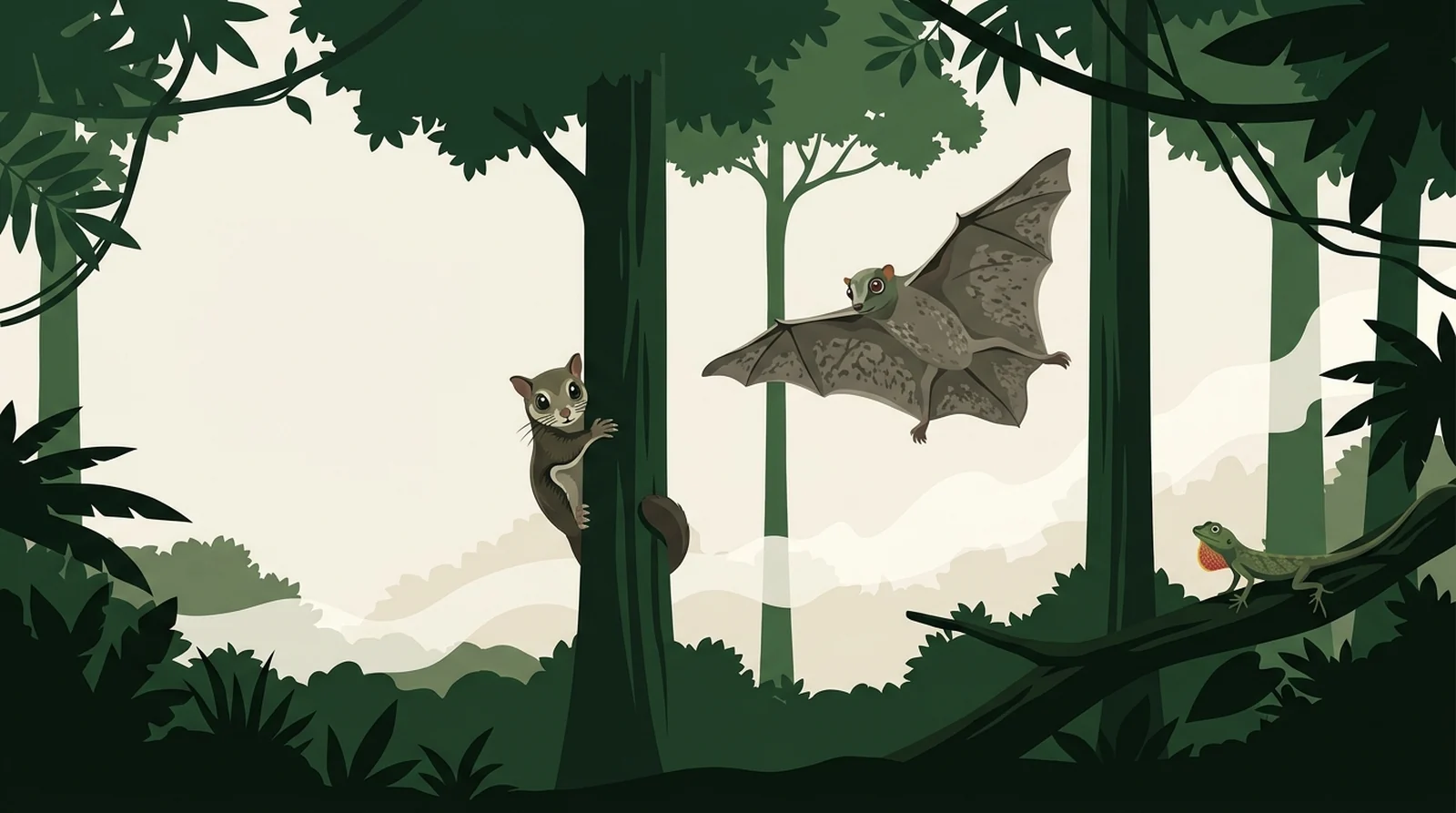
Borneo's aerial wildlife
The gliders of Borneo
Borneo has more gliding vertebrates than anywhere else on earth. Here is how to find the colugos, flying squirrels, snakes and lizards that travel the canopy.
The animal
The dipterocarp forest
Borneo holds more gliding vertebrates than anywhere else on earth, driven by the immense height and isolation of its dipterocarp trees. Colugos, fourteen species of flying squirrel, and even lizards cross the high canopy here without descending to the forest floor. You can look for a flying squirrel from the canopy walkway at dusk, while night drives present a realistic target for the colugo.
The Eocene and Oligocene expansion of dipterocarp forests shaped the entire ecosystem. Unlike the heavily interconnected canopies of the Amazon or Congo basins, Borneo's primary rainforest is highly stratified. A dense main canopy is punctuated by giant emergent trees. The tallest known tropical tree in the world is a yellow meranti standing 100.8 metres high in a sheltered valley within the Danum Valley Conservation Area. Although this specific tree is off-limits to visitors it demonstrates the extreme vertical scale of the environment. In forests with a high density of thick lianas animals can walk between the crowns on natural bridges. Borneo has fewer of these heavy vines. This leaves the tallest trees completely isolated. To cross from one to the next without descending to the dangerous forest floor animals must take to the air.
The trees also dictate the biological schedule. Because dipterocarps fruit heavily at unpredictable intervals of 2 to 10 years, food resources are patchy and scattered. This phenomenon is known as mast fruiting. It forces resident frugivores to travel widely to find the next active tree. Climbing a tall tree trunk demands immense mechanical work against gravity. Gliding does not save an animal energy but it does save a tremendous amount of time. A colugo or a flying squirrel can cross its vast home range in seconds to reach the next fruiting tree. Molecular clock dating shows that nearly all Southeast Asian gliding vertebrate lineages cluster around this period.
The Sunda colugo
The Sunda colugo is entirely distinct from the lemurs it is sometimes named after. Genetic sequencing of rare genomic changes places the order Dermoptera as the closest living sister lineage to all primates. The colugo possesses the most complete aerodynamic membrane of any mammal. The patagium stretches from its neck to its forelimbs, extends down to its hindlimbs and completely encompasses its tail and toes. This creates a vast surface area. It allows the animal to launch from a head-up vertical posture on a tree trunk, execute a swift 180-degree roll and settle into a stable horizontal glide at an average descent angle of 15 degrees. Bio-logging of free-ranging colugos proves they rely heavily on this membrane for all gap-crossing. Colugos are resident in the lowland forests and are regular on the night drive at the Danum Valley Study Centre.
Borneo's flying squirrels
Borneo is home to exactly 14 species of flying squirrel. They range from the massive red giant flying squirrel down to the tiny Hose's pygmy flying squirrel weighing only 21 grams. They use a completely different anatomical mechanism from the colugo. The squirrel supports its gliding membrane with an elongated cartilaginous spur attached to its wrist. During a glide the animal extends this styliform cartilage outward to create an upturned wingtip. This acts in exactly the same way as the winglet on an aircraft. It reduces induced drag by directing turbulent air away from the main lifting surface. The mechanism gives the giant flying squirrels exceptional agility and a high horizontal speed of nearly 9 metres per second. They are a bonus for early risers and a regular sight at dusk for those waiting at the right canopy towers.
Lizards, snakes and frogs
The agamid flying lizards of the genus Draco also account for 14 distinct species across Borneo. These diurnal lizards support their gliding membrane with 5 to 7 greatly elongated thoracic ribs. High-speed camera work has revealed how the lizard controls this membrane. The lizard actively grips the leading edge of the membrane with its forelimbs mid-flight. This creates a composite wing and allows the animal to adjust its angle of attack with minute wrist movements. The lizard then releases the membrane just before landing so its legs are free to run up the trunk.
The paradise flying snake achieves directed flight without limbs or a membrane. By splaying its ribs laterally and rotating them forward it turns its circular body into a concave shape. It then undulates rapidly in the air. Air flowing over the snake's flattened body creates a leading-edge vortex that acts as a powerful suction mechanism. The low-pressure zone gives the snake remarkable lift and the wave motion prevents it from tumbling uncontrollably. It reaches a maximum lift coefficient of 1.9 during a glide.
Borneo also supports flying geckos of the genus Gekko. They rely on scalloped dermal flaps and webbed feet to slow their descent. A glide often ends with the gecko crashing headfirst into a tree trunk at 6 metres per second. They absorb the kinetic impact with their robust skeletal structure and adhesive toe-pads. Wallace's flying frog, assessed as Least Concern by IUCN in 2022, uses massively enlarged webbed feet to steer a parachute-like descent from the high canopy to the breeding pools below. Even the canopy ants of the genus Polyrhachis execute a backward-gliding trajectory to the tree trunk if they are dislodged by wind.
Canopy towers and trails
The different species divide the day between them. The red giant flying squirrel operates on a strict schedule at dusk. The canopy walkway at the Rainforest Discovery Centre in Sepilok places you at eye level with the emergent trees. Because the squirrels routinely use the same hollow trunks, the guides know exactly where to wait between 6pm and 6:30pm for the launch. You can watch the squirrel assess the distance before stretching its membrane taut for a 40-metre glide across the clearing.
The colugo is strictly nocturnal. Guided night drives from Borneo Rainforest Lodge or the Danum Valley Study Centre sweep the mid-to-high canopy with spotlights; Borneo Rainforest Lodge's construction and expansion period runs from 1 January 2025 to 22 January 2027. The colugo's distinctive red or orange eye-shine gives it away as it clings to a smooth trunk before launching into the dark. If you look closely you can see the entire silhouette of the animal against the night sky.
The flying lizards are diurnal and most active mid-morning when the sun warms the lower tree trunks along the Danum Valley trails. They are superbly camouflaged against the bark. Guides locate them by watching for the rhythmic flicking of the bright yellow or red throat flag used by the males to claim territory. A lizard will often scale the trunk before leaping into the canopy to evade predators. The paradise flying snake is seen with luck on branches overhanging the Kinabatangan River by day; after heavy rain, night walks near breeding pools at Danum Valley offer a chance to find Wallace's flying frog.
Photographing gliding animals
The primary rainforest canopy intercepts up to 90% of the available sunlight. This plunges the forest floor into a permanent gloom that photographers call the emerald shadow. Capturing a moving animal in this environment requires specialised optical gear and a complete shift in exposure settings.
You need a fast lens. A 100-500mm f/4.5-7.1 zoom provides excellent framing flexibility for subjects moving unpredictably. A 400mm f/2.8 prime lens is ideal for recovering light under the dense foliage. Freezing the rapid flight of a squirrel or a leaping lizard demands a shutter speed of 1/500s to 1/1000s. To achieve this you must push your camera's ISO to 3200, 6400 or even 12800. A sharp image with digital noise can be processed later. A motion-blurred image is ruined permanently. Spot metering is critical because the animals are frequently heavily backlit by bright gaps in the canopy above. Standard matrix metering will render the subject as a pure silhouette.
Tracking a flying squirrel in flight is almost impossible. The most effective method is to pre-focus your lens on the anticipated landing trunk based on the guide's knowledge of the established glide corridors. For nocturnal species like the colugo, operators strictly enforce the use of red-filtered lights or heavily dimmed beams to protect the animals' highly sensitive retinas. Modern autofocus systems will hunt endlessly in the dark. Photographers must switch to manual focus with focus-peaking enabled and use a beanbag on the vehicle's roll bar to stabilise the camera at the slow shutter speeds required.
Planning your wildlife trip
If the gliding animals are what you are coming for, tell the team which species matter most to you. They will recommend the lodges with the best access to the canopy walkways and night drives. Send your dates and party size and the team will come back with an itinerary that gives you the right amount of time in the forest.
--- Sources referenced on this page: Science (2007), Journal of Experimental Biology (2005, 2011), South East Asia Rainforest Research Partnership (SEARRP), IUCN Red List. Facts verified 9 September 2026.
Related
Keep planning
Best Time to Visit Sabah Getting to Danum Valley Sabah Itineraries
Questions the team is asked
The red giant flying squirrel is seen on most evenings at the Rainforest Discovery Centre and the colugo is regular on night drives at Danum Valley. Finding a flying snake or lizard relies more on luck and sharp guide work.
Operators enforce strict rules on artificial lighting to protect nocturnal eyes. Red-filtered lights are used for spotting. High ISO capabilities are far more useful than an external flash.
The paradise flying snake is mildly venomous to its small prey. It is not considered dangerous to humans. They spend their time high in the canopy or resting over riverbanks and avoid contact.
The specific architecture of the tall dipterocarp trees and a lower density of bridging lianas in Southeast Asia created the unique evolutionary pressure for gliding.
Rain falls all year in Sabah and never closes the forest. Sightings rely more on the time of day and the local fruiting cycles than on the calendar month.
Plan your trip
Plan your forest wildlife trip
Tell the travel team you are coming for the gliding animals, and they will arrange your time on the canopy walkways and night drives.