Semporna marine species guide
The marine life of the Semporna archipelago
The Semporna archipelago holds some of the highest marine biodiversity in the Celebes Sea, from Sipadan's pelagic drop-offs to the macro rubble of Mabul and Kapalai.
The animal
Drop-offs and fringing reefs
One hour by boat from Semporna, the Celebes Sea divides into a deep volcanic pinnacle and shallow sandy rubble beds. Advanced divers descend the 600-metre walls of Sipadan to look for schooling barracuda, turtles and patrolling reef sharks. You can focus your time on the macro life of Mabul or snorkel the recovering fringing reefs of the outer islands.
The Celebes Sea sits within the Coral Triangle providing 3 distinct habitats. The first is the deep oceanic drop-off at Sipadan and Mataking. Sipadan rises steeply from a 600 m seabed. This creates nutrient-rich upwellings that sustain dense algal and sponge ecosystems which in turn attract grazing turtles and pelagic fish. Mataking sits on the edge of the Alice Channel. The trench plunges to over 100 m directly offshore for dramatic wall dives.
The second habitat is the shallow benthic environment found around Mabul, Kapalai and the Seaventures rig. These sandy bottoms are the domain of cryptic species that rely on camouflage or toxicity rather than speed. The third system spans the fringing reefs of the outer islands and the Tun Sakaran Marine Park.
Green and hawksbill turtles
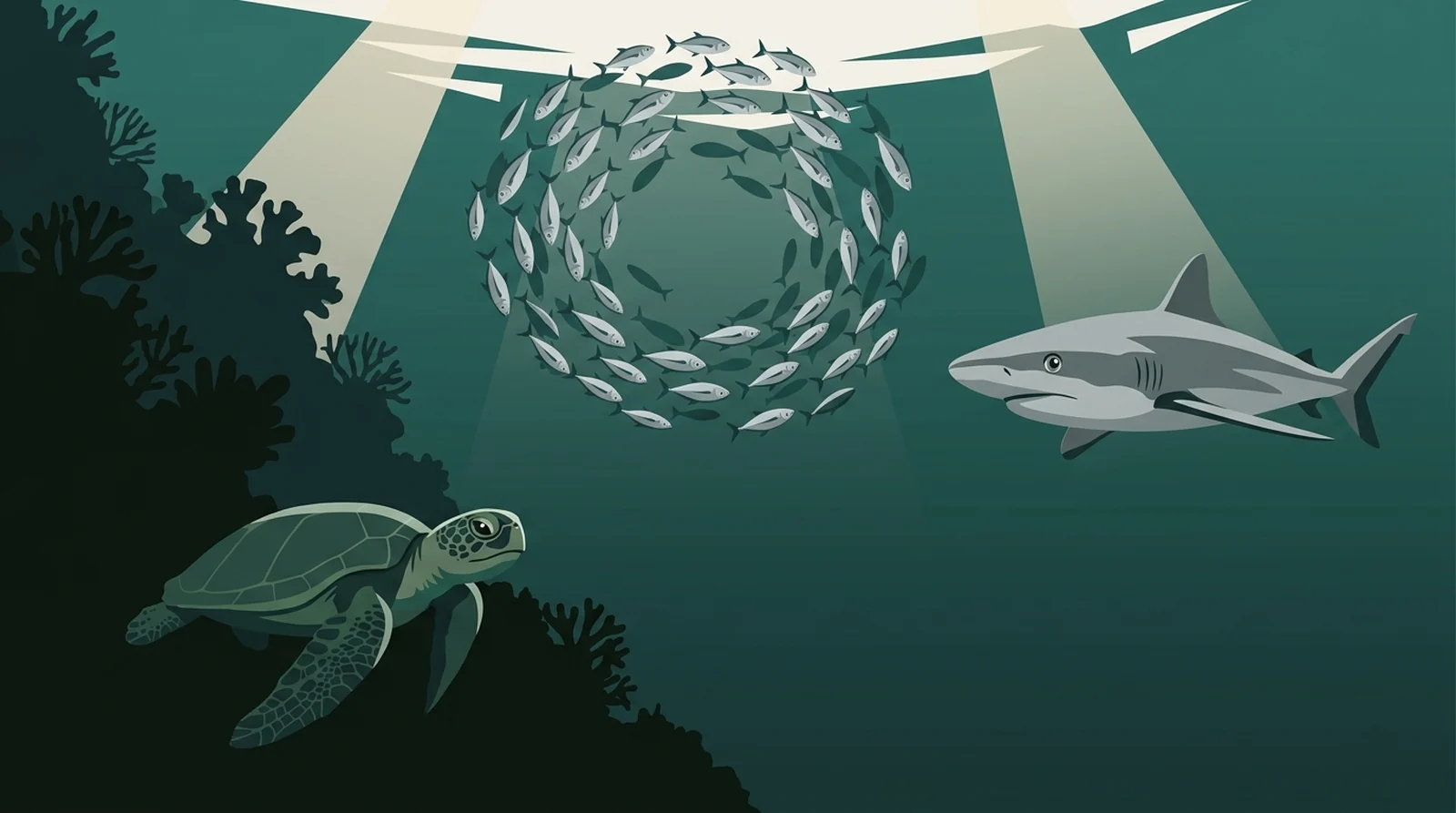
Marine turtles are resident and seen on most stays across the Semporna archipelago. Sipadan is globally known for its extraordinary density of foraging turtles. The green turtle is primarily herbivorous and feeds on benthic algae and seagrasses. The hawksbill turtle uses its narrow beak to extract sponges and tunicates from the reef matrix. The IUCN classes the green turtle as Endangered and the hawksbill turtle as Critically Endangered.
At Sipadan, you will encounter turtles resting on the ledges of the Drop Off or grazing in the shallows. The island's Turtle Cavern has a wide bell-shaped entrance at 14 to 23 m depth. This lets in ambient light and makes it accessible to guided advanced divers. Deep within the cavern lies the Turtle Tomb. This is a dark labyrinth where skeletal remains rest. These belong to turtles that accidentally entered the cave, became disoriented and asphyxiated. Entering the tomb requires full cave diving certification, continuous guidelines and redundant lighting.
Beyond Sipadan, turtles are a realistic target around Mataking, Pom Pom and the Tun Sakaran Marine Park. Pom Pom Island Resort operates a certified hatchery where eggs from green and hawksbill turtle nests on the island's beaches are relocated for protection.
Schooling fish of Sipadan
The massive spiralling tornadoes at Sipadan's Barracuda Point are formed exclusively by the chevron barracuda. By swimming in a synchronised vortex, the barracuda reduce drag. This saves energy while presenting a massive visual target that deters apex predators. They gather in moderate to strong incoming currents between 10 and 30 m depth. Photographers get the best results by silhouetting the school against the sunburst because harsh strobes overexpose their reflective silver scales.
Bigeye trevally form similar swirling aggregations along Sipadan's walls usually slightly shallower between 2 and 15 m. They are highly tolerant of divers and frequently allow respectful groups to drift within the eye of the school.
The bumphead parrotfish is the reef's primary bioeroder. Adult males can reach 130 cm and weigh over 45 kg. They use their heavily ossified foreheads and nodular teeth to ram and excavate live coral framework. This converts the coral into fine calcareous sand. At Sipadan, they sleep in the lagoon and form massive dawn squadrons on most mornings moving collectively along the reef edge between 5:30am and 6:30am to begin their daily feeding cycle. They hold Vulnerable status globally. Sipadan remains one of the few global strongholds where you can watch these protected herds feeding on coral and shaping the reef.
Grey and whitetip reef sharks
The steep walls of Sipadan support resident reef sharks at different depths. The grey reef shark is the dominant medium-sized apex predator and holds Endangered status. They stay close to familiar reefs and maintain established territories along current-swept drop-offs like South Point. The whitetip reef shark spends more time near the seabed and holds Vulnerable status. Because they can actively pump water over their gills, they are often found resting motionless on sandy shelves and in the caverns of Whitetip Avenue.
For divers venturing further offshore to the deep-water atolls of the South China Sea like Layang Layang, the scalloped hammerhead is the prize. These critically endangered sharks aggregate in pelagic environments. Intercepting them requires a deep blue-water descent to reach the cooler thermoclines off the atoll's vertical walls.
If you are hoping to photograph sharks, finding a stable vantage point on the reef and maintaining strict neutral buoyancy is the best approach. Sharks possess highly evolved sensory systems attuned to electromagnetic fields and low-frequency pressure waves. Erratic finning or rapid pursuit will instantly drive them down the wall and out of visual range.
Mandarinfish and flamboyant cuttlefish
Mabul and Kapalai are synonymous with muck diving. The sandy rubble hides a staggering diversity of cryptic life and signature nudibranchs like the bright blue-and-black Chromodoris dianae.
The mandarinfish is a heavily pigmented and scale-less fish that inhabits the shallow coral rubble. They secrete a toxic mucus to deter predation and are most famous for a brief mating dance that happens strictly at dusk between 5:30pm and 6:30pm. They are highly sensitive to light so guides use red light filters. Strobes should only fire at the exact moment of the mating rise to avoid blinding the fish and disrupting the reproductive cycle.
The flamboyant cuttlefish walks along the silty bottom using modified arms. When threatened, it displays a warning pattern rippling with yellow, maroon and white pigment cells. This warning display is genuine because its muscle tissue contains traces of tetrodotoxin.
The blue-ringed octopus is often no larger than a golf ball and possesses a bite laced with the same potent neurotoxin produced by symbiotic bacteria in its salivary glands. The iridescent blue rings are usually concealed and only illuminate brightly when the animal is highly stressed. Strict neutral buoyancy is paramount here. Divers must never touch the substrate or harass the animal to make its rings flash because a flashing octopus is issuing a final warning.
Sipadan walls and Mabul rubble
Turtles are seen throughout the archipelago with the highest densities at Sipadan and nesting sites on Pom Pom. The chevron barracuda, bigeye trevally and bumphead parrotfish are Sipadan specials that rely on the deep oceanic currents and the protected reef flats. Grey reef and whitetip reef sharks patrol Sipadan's walls while scalloped hammerheads require a trip to Layang Layang. The macro specialists including the mandarinfish, flamboyant cuttlefish and blue-ringed octopus are the reason divers stay at Mabul and Kapalai.
If you pre-book on a dive package with the right resort, your Sipadan days can be guaranteed. Sabah Parks issues 254 Sipadan permits a day. The island is closed every November to allow the marine environment a month of rest. It reopens on 1 December.
Recovering coral frames
The coral ecosystems of Semporna present a varied environment. A mass bleaching event hit Sabah's reefs in mid-2024. This affected the shallow flats at Mabul and the Tun Sakaran Marine Park more severely while Sipadan's deeper walls largely escaped the worst surface temperature spikes.
In areas like Tun Sakaran and Pom Pom, the story is one of active ecosystem recovery. Large sections of these reefs were historically devastated by blast fishing. This obliterated the calcium carbonate framework and left unstable coral rubble. Today, marine biologists and volunteers with the Tropical Research and Conservation Centre (TRACC) based on Pom Pom use advanced micro-fragmenting techniques to accelerate radial coral growth up to 25 times the natural rate. They plant these fragments on artificial structures that stabilise the rubble on steep slopes. When you dive or snorkel here, you are diving over a recovering reef where juvenile reef fish are actively recolonising the frames.
Hidden micro-ecosystems continue to yield new scientific discoveries. In 2024 researchers discovered Sipadantonius roihani. This is an entirely new genus and species of marine cave copepod found deep within the Sipadan Turtle Tomb. This discovery highlights the value of Sabah's submerged cave networks.
Shallow gardens and steep walls
Snorkelling is excellent across the outer islands like Mataking, Pom Pom and Timba-Timba as well as the shallows of Sibuan in the Tun Sakaran Marine Park. You will see green and hawksbill turtles, branching corals and recovering reef ecosystems in clear shallow water. The macro life of Mabul and Kapalai sits on sandy bottoms that are mostly out of reach for snorkellers. This makes scuba diving the only practical way to find the cuttlefish and octopuses.
Sipadan has required Advanced Open Water certification for divers since October 2022 because the walls drop steeply and the currents can be strong. Snorkellers also need a Sipadan permit to enter the water there. For any itinerary that sequences diving with an onward flight, allow 24 hours between your last dive and your flight.
Boat transfers and dive packages
The archipelago rewards careful planning whether you are coming for the pelagics of Sipadan or the macro life of Mabul. Send your dates, your party size and your diving certification level. The team will come back with an itinerary that matches the right resort and boat transfers to the marine life you want to see.
--- Sources referenced on this page: Sabah Parks, IUCN, Sabah Wildlife Department, Tropical Research and Conservation Centre (TRACC), Proceedings of the Royal Society B, Journal of Fish Biology. Facts verified 9 September 2026.
Related
Keep planning
Best Time to Visit Sabah Getting to Danum Valley Sabah Itineraries
Questions the team is asked
The marine life is resident all year. Semporna receives around 2,342 mm of rain annually. This means a completely dry day is the exception. March and April are the calmest and least wet months and offer the smoothest boat crossings.
These are highly cryptic animals that match the rubble exactly. Your best chance is with an experienced local guide at Mabul or Kapalai.
Sabah Parks caps access at 254 permits a day to protect the site. A Sipadan permit can be guaranteed with the right resort and dive package; the team confirms what applies to your dates. You will typically have 1 or 2 Sipadan days during a standard stay depending on the resort.
No. The estuarine and riparian networks of Sabah including the Kinabatangan River and coastal mangroves are home to the estuarine crocodile. From 2001 to 2020 there were 70 documented attacks in Sabah. All exploration of these environments must be conducted via localised boat tours.
Yes. The Eastern Sabah Security Zone (ESSZONE) enforces a dusk-to-dawn sea curfew from 6pm to 6am. Tourist boat transfers and remote diving operations conclude by mid-afternoon to ensure vessels are ashore before the curfew; house-reef night dives require explicit police clearance.
Plan your trip
Plan your Semporna diving itinerary
Ask the team about Sipadan permits and Mabul macro diving so they can match you with the right resorts and boat transfers.