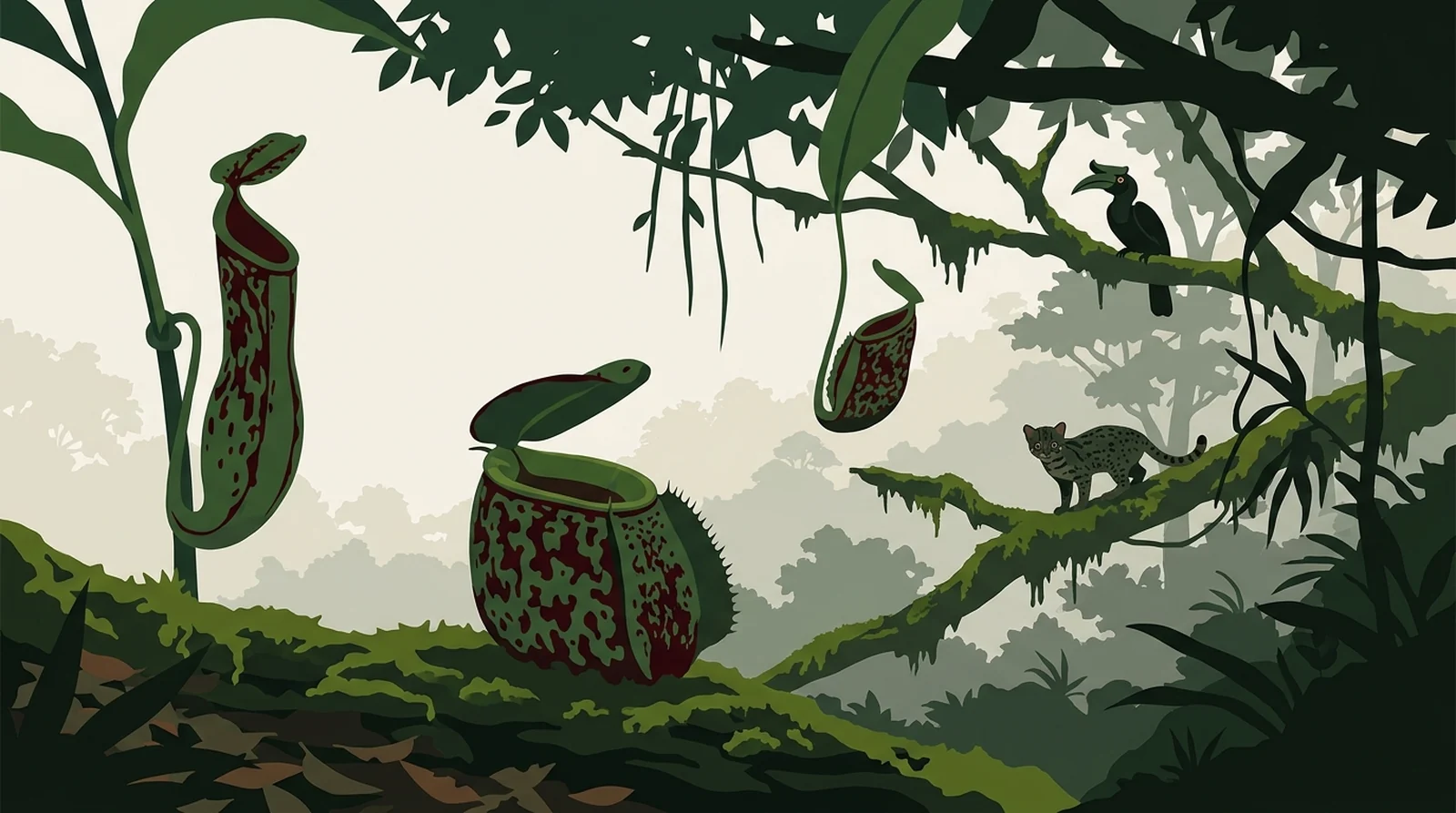
Sabah's endemic Nepenthes
The Pitcher Plants of Borneo
The island of Borneo is the evolutionary centre of the Nepenthes genus. This guide explains how the plants work and where botanists and photographers can find them on the trails of Sabah.
The animal
Borneo's endemic pitcher plants
Borneo holds over 40 species of pitcher plant with the highest concentration of endemics globally. You can look for the giant montane species along the trails of Kinabalu Park or explore the heath forests of the Maliau Basin. Expect to be fascinated by their complex adaptations and the carnivorous mechanics they use to survive on nutrient-poor ridges.
The Nepenthes genus survives where other plants struggle. They thrive in environments with severely nutrient-poor soils such as the ultramafic rock of Mount Kinabalu or the sandstone plateaus of the kerangas heath forests. To compensate for the lack of nitrogen in the ground they grow modified leaves shaped like hollow urns.
Biological pitcher plant traps
A pitcher is an engineered trap. The rim around the opening is the peristome. In lowland insect-trapping species, the peristome is coated in anisotropic slippery waxes. When an insect lands on the rim, it loses its footing on the microscopic wax crystals and falls into the interior. The lower section of the pitcher contains a viscoelastic digestive fluid. The plant absorbs the nutrients as the prey breaks down.
A healthy pitcher is also a living aquatic ecosystem. Organisms that live and breed inside the fluid are called nepenthebionts. The Microhyla borneensis frog breeds almost entirely within the terrestrial pitchers of Nepenthes ampullaria in the Matang Range. Specialised crab spiders anchor a silk dragline to the rim and dive into the fluid to steal prey while dipteran larvae act as detritivores to process the organic matter.
Lowland and montane Nepenthes species
Borneo holds over 40 species. Nepenthes rajah is the largest by volume and is endemic to Sabah. It produces urns up to 41 centimetres high capable of holding up to 3.5 litres of water and 2.5 litres of digestive fluid. As of September 2026, it is listed on CITES Appendix I which strictly prohibits international commercial trade in wild specimens. Its natural hybrid Nepenthes kinabaluensis receives the same protection. All other Bornean species fall under Appendix II.
Nepenthes villosa grows in Kinabalu Park and features a thick woody peristome. Nepenthes edwardsiana is known for its heavily ribbed peristome. Nepenthes albomarginata has a distinctive velvety band of white hairs just beneath the rim. These trichomes serve as a targeted edible lure for lichen-eating Hospitalitermes termites. When a foraging column discovers the pitcher, thousands of workers swarm the rim to harvest the tissue. Hundreds lose their footing on the slick peristome and plummet into the fluid. This massive harvest event provides the plant with over half of its total foliar nitrogen.
Nepenthes bicalcarata grows 2 sharp thorns from the base of the lid and is a true myrmecophyte that relies entirely on a garrison of symbiotic Camponotus schmitzi swimming ants. The plant provisions the ants by growing hollow swollen tendrils that serve as nesting structures and secretes extrafloral nectar from the thorns. In return, the ants act as an aggressive security force that drives away herbivorous insects. The ants are capable of swimming directly through the mildly acidic digestive fluid without losing their grip. They dive into the fluid to retrieve massive insect prey which they haul beneath the peristome to butcher. By removing these large items the ants prevent the sudden release of ammonia that would rot the pitcher. The plant then passively absorbs the easily digestible nitrogenous waste left behind by the ant colony.
Pitcher plants and mammal partners
At high elevations in the Crocker Range and Mount Kinabalu, insect prey is scarce. A guild of 3 giant pitchers has evolved a remarkable coprophagous partnership with small mammals. Nepenthes lowii, Nepenthes rajah and Nepenthes macrophylla produce a sugary exudate on the underside of their reflexed lids. Unlike lowland species that use highly slippery peristomes, these montane species have heavily ridged or highly reduced rims to deliberately prevent the visiting mammal from slipping into the fluid. The distance from the front of the orifice to the nectar glands exactly matches the head-to-body length of the mountain treeshrew. The animal is forced to straddle the wide rim to access the dense nectar reward. While feeding, it defecates into the fluid below and uses the pitcher as a high-altitude toilet. Stable isotope analysis shows that mature Nepenthes lowii plants derive much of their foliar nitrogen from treeshrew droppings.
The mutualism possesses a fascinating nocturnal dimension. While the mountain treeshrew is strictly diurnal, the plant's nutrient acquisition continues after dusk. Nepenthes rajah actively emits a blend of over 40 volatile compounds to attract the endemic summit rat during the night. By feeding treeshrews by day and rats by night the plant doubles its potential nutrient intake and reduces direct competition between its mammalian partners.
In the lowland peat swamp and heath forests, Nepenthes hemsleyana partners with Hardwicke's woolly bat. The upper aerial pitchers are remarkably elongated and strongly tapered near the base. This creates a physical space that accommodates the body size of the mammal. The rear wall of the pitcher acts as a highly efficient parabolic acoustic reflector. It bounces the bat's ultrasonic echolocation calls back as a biological beacon in the dense jungle. Unlike its carnivorous relatives the pitcher maintains an exceptionally low fluid volume to provide a dry and stable roosting space. The plant expends considerable energy to grow these giant structures which yield very poor insect-trapping rates. The return on investment comes entirely from the bat which roosts inside during the day and defecates into the lower fluid reservoir to provide the plant with a substantial portion of its total nitrogen.
Parks and forest trails
The trails of Sabah offer varied habitats for observing these plants. Field conditions dictate where the different species are accessible.
The botanical garden near the Kinabalu Park Headquarters at 1,500 metres provides the most accessible viewing. The site is beautifully maintained and you can look for Nepenthes rajah, Nepenthes edwardsiana and Nepenthes burbidgeae without violating the strict off-trail regulations. It is the designated alternative to the Mesilau trail which was destroyed by the 2015 earthquake and remains strictly closed.
The main trail from Timpohon Gate is demanding and gives you access to high-altitude pitcher plants. The trail climbs steeply from 1,866 metres through the montane and sub-alpine forest. You can focus on altitude adaptations and scan the canopy for epiphytic pitcher plants as you ascend.
Exploring the kerangas heath forest of the Maliau Basin means trekking for several days over sandstone terrain. In Maliau Basin, Nepenthes veitchii is a realistic target. This species wraps its wide flattened peristome around tree trunks like a climbing harness. Nepenthes ampullaria is also resident here.
The Gunung Alab Substation sits at 1,951 metres and offers excellent access to primary montane cloud forest. The paved ridges allow for low-stress viewing of high-altitude flora outside the quota system of Kinabalu.
Located on the coast of Sarawak, the Lintang and Tajor trails rise rapidly to sandstone plateaus baking in the equatorial sun. Bako is widely considered the finest lowland viewing site. It is an excellent location to look for the termite-specialist Nepenthes albomarginata alongside Nepenthes rafflesiana and Nepenthes gracilis.
Tawau Hills Park and Poring Hot Springs offer excellent lowland rainforest trails and managed conservation gardens. You can look for Nepenthes mirabilis and Nepenthes gracilis on these walks. Pitchers are sparser in Tawau due to the rich volcanic soils as carnivorous plants prefer nutrient-poor ground. Guides here focus on standard lowland insect-trapping mechanics.
Protected wild pitcher populations
Nepenthes are highly prized in the illegal horticultural trade. Commercial poaching syndicates target the endemic Bornean species and the plants cannot absorb the pressure. They are restricted to isolated nutrient-poor ridges and are highly vulnerable to extraction. The team enforces a zero-tolerance geotagging policy on all itineraries. Guests must not record or share the exact coordinates of rare off-trail species like mature Nepenthes rajah or Nepenthes clipeata. Any evidence of freshly cut vines or off-trail excavation is reported immediately to the park rangers.
Macro photography techniques
Nepenthes are challenging photographic subjects due to the extreme contrast of the bright tropical sun piercing the dense canopy. Use a macro lens to focus on the ribbed peristome and the nectar glands under the lid. Point the camera downward to capture the fluid and the internal fauna to create a strong ecological record.
The dark understorey requires artificial light. A ring flash or an off-camera diffused LED panel works best. Direct hard flash will blow out the waxy textures of the pitcher walls and flatten the intricate ribs. The team enforces a strict no-touch policy on all treks. You must never tilt a pitcher to get a better angle. Spilling the fluid destroys the plant's energetic investment and kills the micro-fauna inside. Bare hands degrade the epicuticular wax crystals that make the traps function.
Your botanical trekking itinerary
If high-altitude botany and the montane pitcher plants are what you are coming for tell the team which species matter most and they will build the trekking itinerary around them. Send your dates and the size of your group so the team can secure the right permits and mountain guides for your stay.
--- Sources referenced on this page: CITES Appendices and Resolution Conf. 11.11; New Phytologist (Chin et al., 2010); Biology Letters (Clarke et al., 2009; Grafe et al., 2011); PLoS ONE (Greenwood et al., 2011; Bazile et al., 2012); Current Biology (Schöner et al., 2015); Annals of Botany (Moran & Clarke, 2001); Zootaxa (Das & Haas, 2010); Plants of the World Online (POWO); Sabah Parks. Facts verified 9 September 2026.
Related
Keep planning
Best Time to Visit Sabah Getting to Danum Valley Sabah Itineraries
Questions the team is asked
No. Most species trap insects. While historical records show drowned rodents inside the giant Nepenthes rajah, these are very rare fatal accidents. A large mammal falling into the trap can rot the leaf tissue and kill the pitcher.
No. The 2015 earthquake and the resulting mudslides destroyed the Mesilau facilities and decimated the local pitcher populations. The trail remains strictly closed to the public.
No. It is a criminal offence to remove flora from protected areas in Sabah. Purchasing undocumented plants fuels the illegal trade that threatens the wild populations.
You need a climbing permit to access the summit trail above Timpohon Gate. The botanical garden near the park headquarters is accessible without a climbing permit.
No. This massive pitcher plant is strictly endemic to the ultramafic soils of Mount Victoria in Palawan in the Philippines.
Plan your trip
Plan your botanical trekking tour
Tell the team which pitcher plant species you want to see and they will design your trekking itinerary around the right trails.